












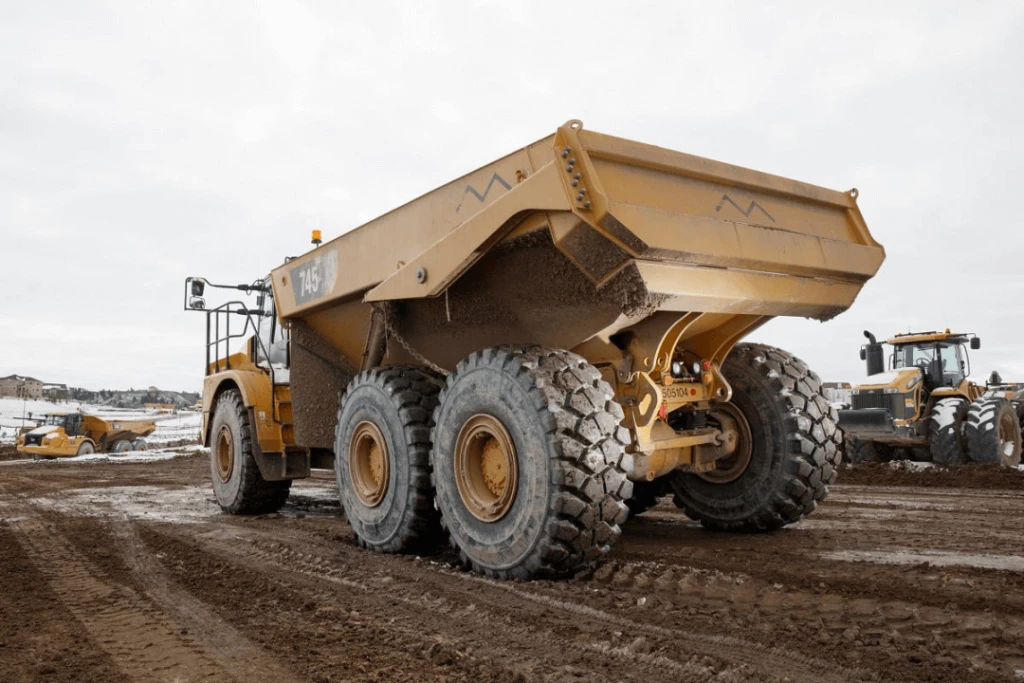
The tread pattern of an OTR tire has a direct impact on traction, wear resistance, cut resistance, and operating cost in mining, earthmoving, construction, industrial, and material handling applications. For overseas tire distributors and sourcing customers, understanding tread pattern logic helps build a more suitable product portfolio for end users.
1. Rock patterns: for sharp rocks and heavy-duty conditions
Rock patterns are among the most common OTR tire tread designs. They are usually used in mines, quarries, and other heavy-duty environments where sharp rocks may cause cuts, punctures, and impact damage. This type of tread focuses on cut resistance, puncture resistance, wear performance, and stable traction.
For loaders, mining vehicles, and selected earthmoving equipment, rock patterns are often more suitable than ordinary traction patterns when the working area includes broken stone, sharp surfaces, or high impact risks. The final choice should still be based on vehicle type, working hours, load level, and ground hardness.
2. Traction patterns: grip, braking, and mobility
Traction patterns are commonly used on graders, loaders, dozers, and earthmoving equipment. They rely on a larger contact area and multiple biting edges to provide stronger grip and braking performance on loose soil, mud, or unpaved surfaces.
When end users are more concerned about mobility, slope operation, wet ground, or complex earthmoving conditions, traction patterns are an important option. For distributors, these products can be positioned around construction projects, infrastructure work, and regional earthmoving demand.
3. Block patterns: balanced use on soft and hard surfaces
Block tread patterns usually consist of individual blocks, diamonds, buttons, or chevron-like structures. They are designed for working environments that switch between soft and hard surfaces, balancing traction, stability, and wear performance.
In sandy ground, loose soil, mixed surfaces, or complex construction sites, block patterns can provide relatively stable grip. For distributors serving different types of end users, block pattern OTR tires often offer good value in product portfolio planning.
4. Rib and smooth patterns: for specific industrial applications
Rib patterns usually provide lower rolling resistance and are often used on industrial tractors, backhoes, finish graders, and equipment that requires directional stability and continuous operating efficiency. This type of tread focuses on stable running, lower energy loss, and smoother ground contact.
Smooth patterns are commonly used on compactors, rollers, selected loaders, and material handling equipment. When end users value durability, uniform contact, and surface compaction more than strong traction, smooth tires can be a suitable choice.
5. Tread depth and tire construction also matter
Apart from tread pattern type, tread depth is another key factor in OTR tire selection. Common options include regular, deep, and extra-deep tread. In general, deeper tread can improve wear and cut resistance, but it may also affect heat dissipation, tire weight, and cost.
Tire construction should also be considered. Radial OTR tires usually have advantages in contact area, traction, heat dissipation, and long working hours. Bias OTR tires may offer stronger sidewall stability and more manageable initial purchase cost. Neither structure is always better; the key is whether it matches the vehicle, ground surface, and operating intensity.
- Mines and quarries: Focus on cut resistance, puncture resistance, and deep tread requirements.
- Earthmoving and construction sites: Evaluate traction, braking, and ground adaptability.
- Industrial and material handling: Pay more attention to stability, wear resistance, and continuous operation efficiency.
- Distributor inventory planning: Build a product portfolio based on common equipment and working conditions in the target market.
The key to OTR tire sourcing is not choosing the “strongest” tread pattern, but choosing the product solution that best fits the operating condition and total cost of use.
Conclusion
For international tire distributors and wholesale buyers, understanding OTR tread patterns helps serve mining, construction, industrial, and fleet customers more professionally. A suitable combination of tread pattern, tread depth, and tire construction can help end users balance traction, durability, and operating cost.
Lucky Lion Tire can support overseas customers with OTR tire product portfolio advice, supply resource matching, and order coordination based on target market, vehicle type, working conditions, and sourcing budget. Specific sizes and tread choices should be confirmed according to actual product data and end-use requirements.