












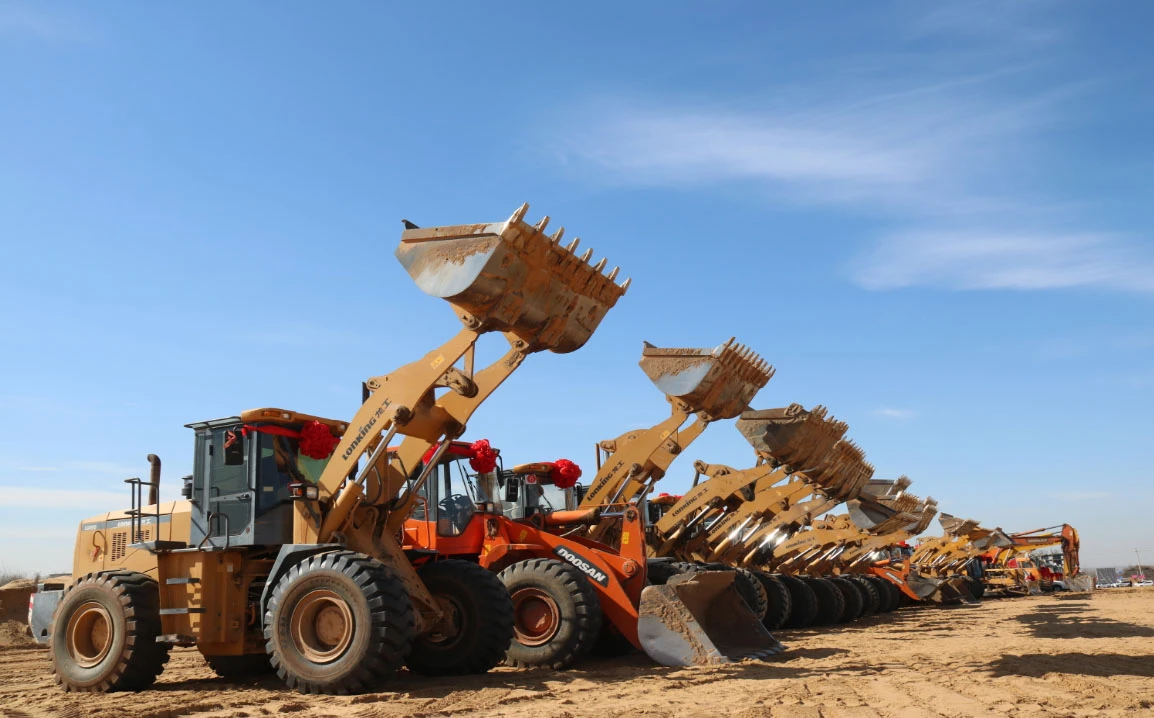
Wheel loaders are one of the most common machines using OTR tires, but their working conditions are not limited to mining and rock surfaces. On construction sites, earthmoving projects, farms, livestock operations, stockyards, demolition sites, and port support operations, loaders often face soil, gravel, mud, wet surfaces, short-distance turning, and frequent stop-start work. Tire selection therefore needs to consider traction, wear resistance, cut resistance, sidewall protection, footprint stability, and maintenance cost.
1. Loader tires should not always be selected like mining tires
When buyers think about loader tires, rock tread and deep tread often come first, because loaders are widely used in mines, quarries, and broken stone environments. In real markets, however, many loaders spend more time in earthmoving, farm work, silage handling, muddy yards, mixed construction sites, or semi-paved areas.
In these applications, the main challenge is often not only cut resistance. It is also grip under low-speed high-torque operation, mobility on wet ground, wear from frequent turning, and stability under load. If buyers always choose an overly deep, heavy, or unsuitable rock pattern for these conditions, they may create unnecessary cost, heat, or wear issues.
2. Soil and farm applications need traction and self-cleaning
On farms, livestock operations, earthmoving sites, and stockyards, loaders are often used for pushing, loading, leveling, transferring, and short-distance handling. Ground conditions may include wet soil, mud, grass, gravel, or organic material. The tread pattern needs enough biting edges and self-cleaning ability so that mud does not fill the grooves and reduce grip.
For these conditions, traction or block patterns are often worth evaluating more carefully than a pure rock pattern. Buyers should look at lug angle, groove openness, shoulder grip, and the continuity of the contact area. A pattern that is too closed may reduce mud evacuation, while an overly open pattern may increase hard-surface wear and reduce roading stability.
3. Where all-steel radial construction can add value
All-steel radial OTR tires generally use steel belts and radial casing construction to create a larger contact area, a more even footprint, and better tread stability. In suitable applications, this can support traction, reduce irregular wear, and improve machine ride quality.
For loaders, radial construction is often worth considering when the job is intensive, daily working hours are long, ground conditions vary, or the customer wants to reduce long-term cost per operating hour. However, if the application is mainly low-speed, short-duration, high-impact, or highly budget-sensitive, bias construction can still be practical. The right structure depends on machine type, tire position, load, speed, and maintenance capability.
4. Lug angle and shoulder design affect real traction
Loaders need effective traction when scooping, pushing, climbing, and starting on wet ground. Lug angle, groove depth, shoulder support, and center footprint all affect grip, mud evacuation, turning wear, and stability on hard surfaces.
In general, the outer shoulder should provide enough grip and lateral support to keep the loader stable while turning or carrying load. The center area should maintain continuous contact and control wear on harder surfaces. For distributors, evaluating a loader tire should not be based only on tread appearance; it must be matched to real ground conditions and operating style.
5. Common loader applications and selection direction
- Farms and livestock operations: Focus on soil traction, self-cleaning, low-speed stability, and wet-ground adaptability.
- Earthmoving and construction sites: Balance traction, wear resistance, cut resistance, and wear from short-distance frequent turning.
- Quarries and gravel yards: Focus more on tread cut resistance, sidewall protection, deep tread, and casing strength.
- Stockyards and industrial sites: Evaluate hard-surface wear, load stability, even ground contact, and continuous operating efficiency.
- Mixed conditions: Choose broader-application patterns and constructions instead of a product designed for only one extreme condition.
6. Size, rim, and replacement plans must be checked carefully
Common loader OTR sizes include 20.5R25, 23.5R25, and 26.5R25 in many markets and machine types. However, suitability should not be judged by size alone. Rim specification, load capacity, speed capability, equipment manual requirements, clearance, and actual working conditions all need to be confirmed.
If a customer wants to move from bias to radial construction, or from one tread type to another, rim compatibility, inflation recommendations, equipment requirements, and axle matching should be reviewed in advance. Mixing different constructions, different wear levels, or different outside diameters may affect machine stability and drivetrain performance, and should be handled carefully.
7. Tire pressure and maintenance decide whether the tire can perform
Even when the tread and construction are correctly selected, poor pressure maintenance can still lead to abnormal heat, sidewall damage, lug tearing, irregular wear, or early failure. Under-inflation increases casing deformation and heat risk, while over-inflation may affect footprint, comfort, and cut risk.
For mines, farms, and construction fleets, a basic maintenance routine is recommended: check cold inflation pressure regularly, record tire position and working hours, observe cuts and lug wear, and address trapped stones or abnormal bulging quickly. Stable maintenance often reduces long-term tire cost more effectively than simply buying a higher-grade tire.
8. How overseas distributors can plan a loader tire portfolio
For overseas tire distributors, a loader tire portfolio should not be built around one “universal” pattern. A more practical approach is to build different product directions for soil traction, rock cut resistance, mixed conditions, and industrial hard-surface use based on the main applications in the target market.
- Start with customer industry: Farms, construction, quarries, mines, ports, and industrial sites have different needs.
- Check ground conditions: Soil, gravel, hard surfaces, wet ground, and mixed surfaces affect tread selection.
- Review operating style: Short-distance loading, long working hours, frequent turning, and climbing require different tire features.
- Confirm supply planning: Define core stock based on common sizes, lead time, inventory capability, and replenishment cycle.
The key to loader tire selection is not applying a mining tire mindset to every job, but choosing an application-based solution according to real ground and operating conditions.
Conclusion
Loaders are widely used across mining, construction, farm, and industrial markets. Tire selection directly affects traction, wear, downtime risk, and long-term purchasing cost. For overseas importers and distributors, professional loader tire sourcing should start with a working-condition review, not with a single quotation.
Lucky Lion Tire can support overseas customers with loader OTR tire portfolio advice, supply resource matching, quotation comparison, and order coordination based on target market, machine type, ground condition, size requirement, and sourcing budget. Specific size, rim compatibility, inflation pressure, load capacity, and performance parameters should be confirmed according to equipment manuals, tire product data, and real end-use conditions.